If you’re dealing with heel pain, arch pain, plantar fasciitis, or sore feet at the end of the day, your shoes may be the real problem.
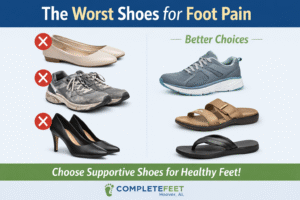
Many patients who come into Complete Feet are surprised to learn that the shoes they wear every day are actually making their pain worse. The wrong footwear doesn’t
just cause discomfort—it can increase inflammation, strain your arches, and throw off your entire alignment.
Here are the worst types of shoes for foot pain—and what to choose instead.
1️⃣ Completely Flat Shoes
Shoes with little to no arch support (like flat sneakers, thin casual shoes, or fashion flats) force your plantar fascia to do all the work.
Why they’re a problem:
-
No arch support
-
Poor shock absorption
-
Increased heel strain
Better option:
Look for structured shoes with firm arch support and removable insoles (so custom orthotics can fit properly).
2️⃣ Worn-Out Running Shoes
Even good running shoes become bad shoes once they’re worn down.
Why they’re a problem:
-
Midsole compression
-
Uneven wear patterns
-
Reduced stability
Most athletic shoes lose support after 300–500 miles. If your shoes tilt inward or feel soft and unstable, it’s time to replace them.
3️⃣ Flip-Flops and Thin Sandals
These are among the biggest contributors to heel pain, especially in warmer months.
Why they’re a problem:
-
No heel stability
-
No arch structure
-
Forces toes to grip while walking
Better option:
Supportive sandals with contoured footbeds and proper arch structure.
4️⃣ High Heels
Heels shift your body weight forward, placing excess pressure on the forefoot and altering alignment.
Why they’re a problem:
-
Increased forefoot pressure
-
Tightened calf muscles
-
Higher risk of plantar fasciitis
If you must wear heels, choose lower, thicker heels and limit duration.
5️⃣ Ultra-Soft, Over-Cushioned Shoes
Surprisingly, shoes that feel extremely soft aren’t always better.
Why they’re a problem:
-
Too much instability
-
Lack of structural support
-
Can worsen overpronation
Cushioning is helpful—but structure matters more.
What to Wear Instead
The best shoes for foot pain have:
✔ Firm arch support
✔ A stable heel counter
✔ Good shock absorption
✔ Removable insoles
✔ Proper fit (not too tight, not too loose)
Even the best shoes, however, may not fully correct underlying biomechanical problems. That’s where custom orthotics make the difference.
Shoes Help. Structure Fixes.
At Complete Feet in Hoover, AL, we help patients combine proper footwear with true custom orthotics for long-term relief—not temporary cushioning.
If your feet hurt despite trying different shoes, it may be time to address the root cause.
Call 205-822-1606 to schedule your custom orthotics consultation today.
Leave a Reply